



Expert Insight : What makes Almacam Tube different for tube cutting?
Programming a tube cutting machine involves much more than converting a CAD file into an NC program. Part geometry, machine architecture, axis movements, accessibility and collision risks all have to be considered before cutting starts.
From the early development of its tube cutting software, Alma has made specific technical choices to address this complexity: automate as much of the programming process as possible, adapt the software to the actual machine configuration, and simulate what will happen on the machine before the program reaches production.
Gabriel Jaubert, Almacam Tube expert at Alma, explains the key principles behind this approach.
About the expert
Gabriel Jaubert has been working on Almacam Tube for 12 years. As a support engineer specializing in 3D cutting applications at Alma, he has extensive experience in CAD/CAM programming for tube and profile cutting machines, including complex machine configurations and kinematics.
Let’s take a closer look at the technical principles Gabriel highlights and how they translate into tube cutting programming.
Automating tube programming from CAD import to the NC program
Automation has been one of the core principles behind the development of Almacam Tube.
The objective is to automate as many programming tasks as possible, from part import and preparation to the generation of the final machine program.
This becomes particularly important when production involves large numbers of parts. Repetitive programming operations should not become a bottleneck: the software must be able to process straightforward jobs quickly while leaving programmers in control when more complex parts require specific decisions.
Adapting the software to the actual tube cutting machine
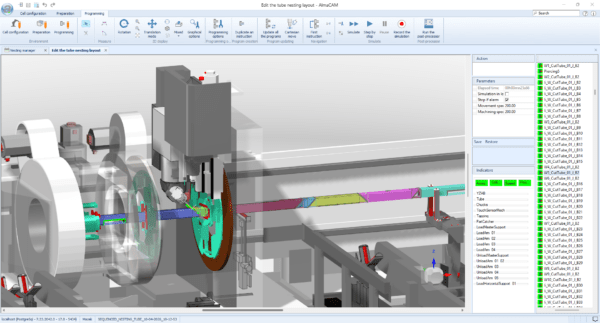
Tube cutting machines can have very different architectures. Depending on the machine, programmers may have to deal with multiple axes, moving cutting heads and configurations with two, three or even four chucks.
The CAD/CAM software must therefore understand more than the geometry of the part. It also needs to take into account how the actual machine moves and operates.
This is a key principle behind Almacam Tube: the software adapts to the machine, rather than forcing the machine into a predefined software model. This allows Almacam Tube to program a wide range of tube cutting machines, including machines with complex architectures and kinematics.
Handling both simple jobs and complex tube parts
Not every tube cutting environment has the same requirements. Some manufacturers need to program large quantities of relatively simple parts as quickly as possible. Others produce prototypes, small batches or highly complex parts that require much more advanced programming.
A tube cutting CAD/CAM system therefore needs to combine automation with the ability to manage complexity.
Over the years, Alma has developed dedicated functions to automate operations that would otherwise require significant manual preparation.
For example, Almacam Tube can create connections between tubes and prepare bent tube geometries for cutting, making complex manufacturing operations easier to program. These capabilities extend the range of tube parts that can be prepared directly within the CAD/CAM workflow.
Simulating machine movements before cutting starts
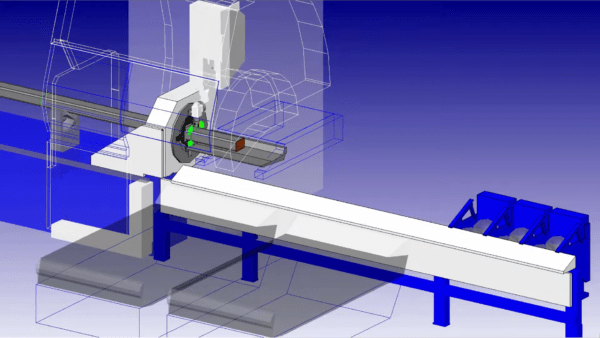
Generating a geometrically correct cutting path is not enough if that path cannot be executed safely on the actual machine.
Almacam Tube simulates the movements of the machine to verify the program before it is sent to production. This simulation helps programmers identify two particularly important issues:
- Accessibility: can the machine physically reach and cut the programmed area?
- Collision risks: could the tube, cutting head, chucks or other machine components collide during the operation?
By considering the real movements and constraints of the machine during programming, potential problems can be identified before the program reaches the workshop.
For operators, this provides greater confidence that the programmed job can be executed on the machine as intended.
Tube cutting software built around automation and machine reality
The complexity of tube cutting comes from the interaction between the part and the machine used to manufacture it.
Part geometry influences machine movements. Machine kinematics determine accessibility and collision risks. These constraints influence programming choices — and ultimately production performance.
This is why advanced tube cutting software cannot focus on geometry alone.
By combining programming automation, support for complex tube geometries, adaptation to different machine architectures and simulation of actual machine movements, Almacam Tube is designed to bridge the gap between the CAD model and what can actually be produced on the machine.
Explore Almacam Tube
Discover how Almacam Tube supports the programming of tube and profile cutting machines, from part preparation and nesting to machine simulation and NC program generation.