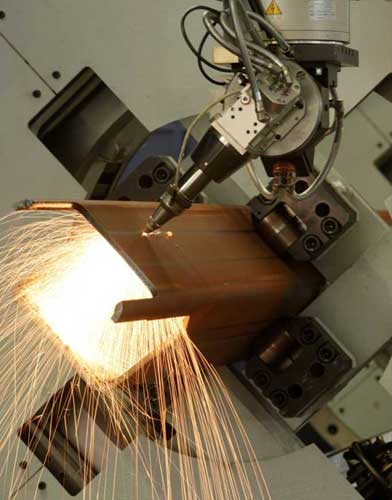
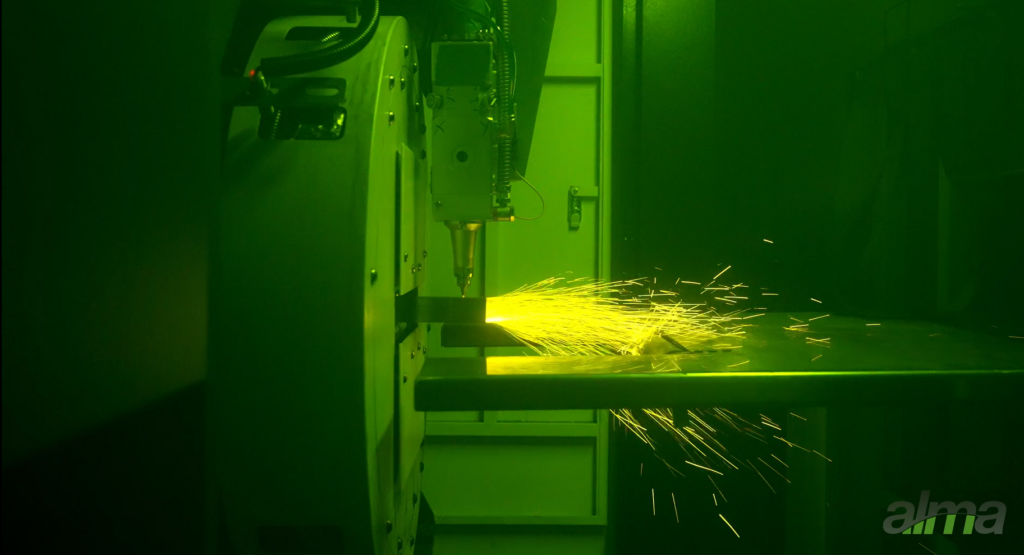
Tube and profile cutting covers a wide range of parts, processes and machine configurations. From standard tubes to complex profiles, and from 2 mandrels lasers to multi-axis and multi-chuck machines, each configuration creates specific programming requirements.
Part geometry, nesting, machine kinematics, cutting strategies and collision risks all have to be managed before production. The more advanced the machine, the more important the role of CAD/CAM software becomes.
Tubes and profiles-cutting technologies
Technological breakthroughs over the last few years now make it possible to build highly automated, flexible tube cutting machines and robots, using increasingly sophisticated mechanisms: complex kinematics with multiple rotative axes, loading/unloading units, coupling and clamping systems, sensing units, etc. Other complex machines combine laser technology with mechanical operations such as conventional drilling, friction drilling, threading, countersinking or counterboring.
Different technologies such as laser, plasma and oxy-cutting are used to cut tubes and profiles with varied dimensions, geometries and thicknesses. Laser cutting combines speed, precision (+/- 0.2 mm) and burr-free cutting quality up to a thickness of approximately 20 mm, whereas plasma and oxy-cutting make it possible to cut thicker tubes at a lower cost.
The application fields for cutting tubes and sections are extremely varied: metal furniture, automobile industry, agricultural machinery, various consumer goods, and of course metal structural frameworks.
The variety of parts, processes and machine configurations has a direct impact on how production is programmed.
Tube nesting and material optimization
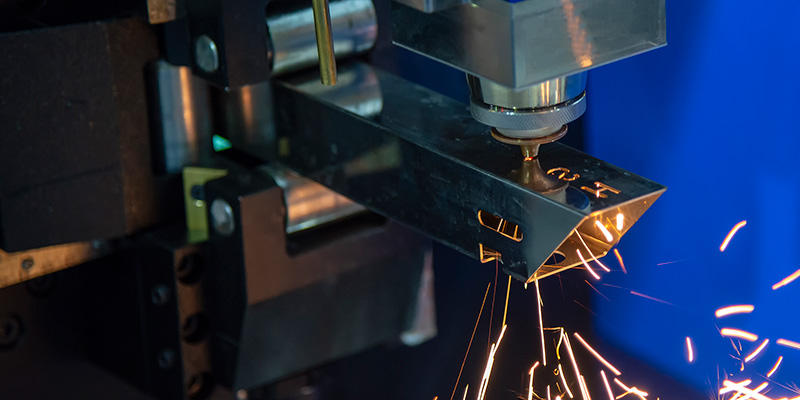
Generally speaking, tube nesting determines how the parts to produce are positioned across the available tubes or profiles. The objective is to use material efficiently while respecting the conditions under which the parts will actually be cut. This is a very specific challenge. At Alma, nesting has been a dedicated R&D field for more than 45 years, and our algorithms are developed in-house.
Why do tube nesting results differ? Explore the challenges behind tube nesting optimization
Programming advanced tube cutting machines
Modern tube cutting machines can have complex kinematics, with multiple axes, chucks, cutting heads, supports, and loading or unloading systems. Programming them requires coordinating all these elements while taking into account the actual movements and limits of the machine. The CAD/CAM software must also anticipate potential collisions between the cutting head, the tube, the chucks and other machine components, especially when cutting complex geometries or bevels.
What makes tube cutting programming so challenging? → Understand the complexity of tube cutting
Why specialized CAD/CAM software is needed for tube cutting
Programming a tube cutting machine involves many parameters, from part geometry and nesting to cutting paths, machine kinematics and collision risks.
Specialized CAD/CAM software takes these constraints into account during programming and automates much of the job preparation. This helps ensure programs are ready for production, reduces manual work and makes better use of the machine’s capabilities.
Almacam Tube: one CAD/CAM environment for different machines
Almacam Tube is CAD/CAM software designed to program all types of tube and profile cutting machines, including the most complex multi-axis and multi-chuck configurations.
It automates programming from CAD import to NC code generation and uses Alma’s in-house nesting algorithms to optimize material usage. Its 3D simulation takes the machine’s actual kinematics into account to anticipate collisions and ensure reliable production.
Tube cutting machines supported by Almacam
Almacam Tube can program tube and profile cutting machines from numerous builders, with configurations adapted to their specific architectures and kinematics.
Tube cutting programming in practice
See how subcontractors and manufacturers use Almacam Tube with different machines, technologies and production configurations.