Almacam 4.1.2: a turning point that takes CAD/CAM workflow further than ever
Published on 15/03/2026
The new version of Almacam introduces two major improvements: Almacam Robotics, a solution dedicated to offline programming for both cutting and welding robots, and a new version of Almacam Bend, dedicated to press brake programming. These developments extend the Almacam CAD/CAM workflow beyond cutting to cover robotic operations and bending within a single unified environment.
This release also brings improvements in nesting and overall performance, and provides information on resource consumption.
Almacam Robotics: offline programming software for cutting and welding robots
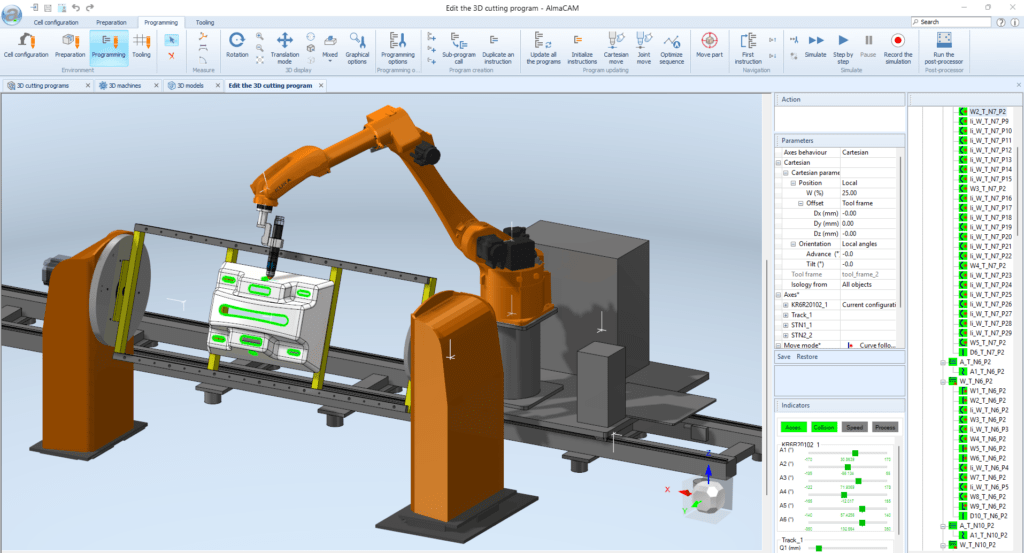
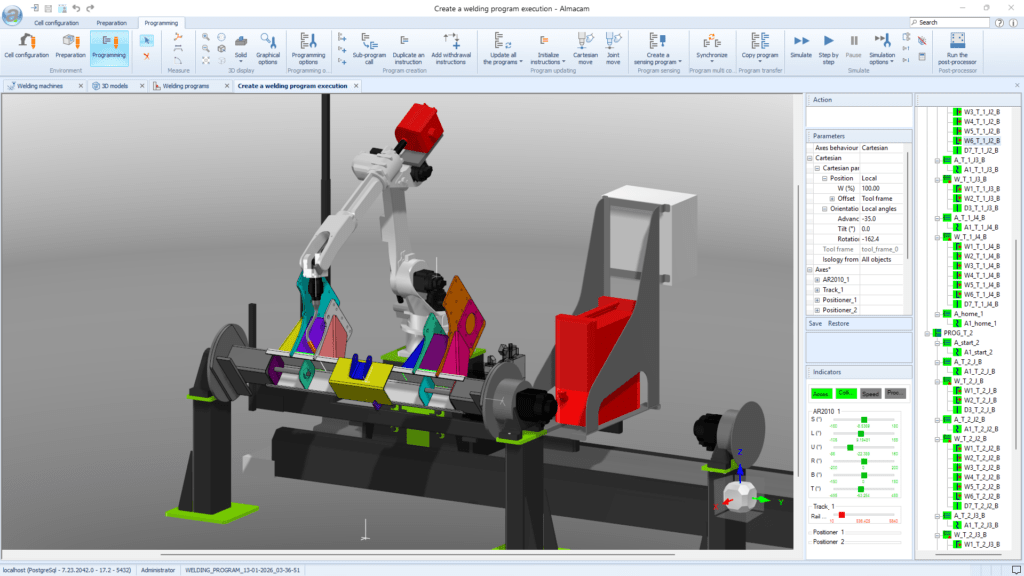
The new version of Almacam introduces Almacam Robotics, an Offline Programming module dedicated to cutting and welding robots, offering a new interface and a unified workflow.
In addition to cutting machine programming, Almacam now offers to create digital twins of robotic cells, simulate robot trajectories, and check collision avoidance in a single environment.
New bending solution
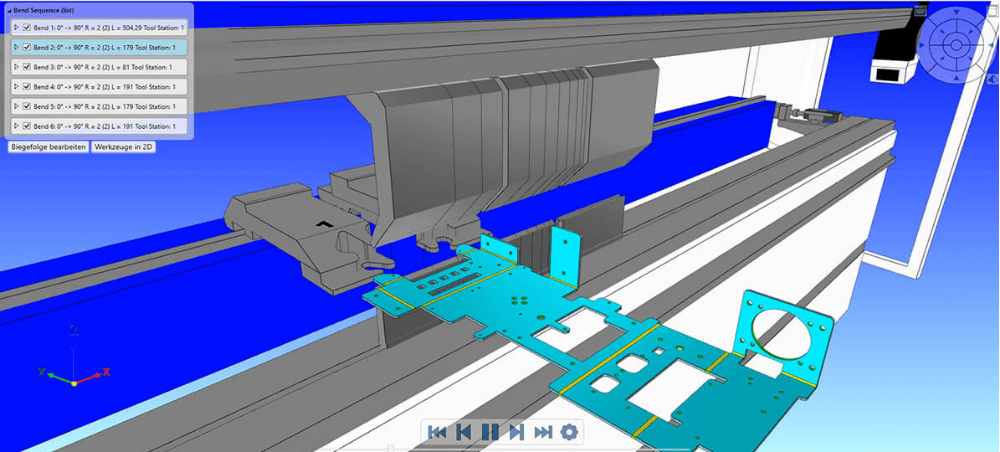
For workshops requiring a complete CAD/CAM workflow—from part preparation to bending operations alongside cutting—the Almacam Bend module extends the process to include press brake programming. Combined with assembly import, unfolding, nesting, and cutting program generation, the software analyzes part geometry and determines bending parameters according to the constraints of the press brake used.
Even more efficient nesting
2D nesting improvements
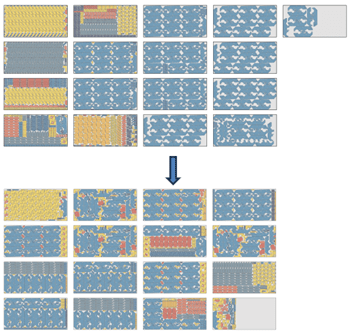
As developers of nesting algorithms, we continuously improve 2D part placement performance for Almacam Cut in every release. In Almacam 4.1.2, this results in an overall optimization, delivering a 0.15% material gain compared to the previous version.
In particular, significant improvements can be observed with:
- Very short optimization times (10s or less): about 1.5% material gain,
- Common cut and multi-heads management: about 1% material gain,
- Nesting layouts with L-offcuts and many sheets: about 1% material gain.
Nesting of profiles
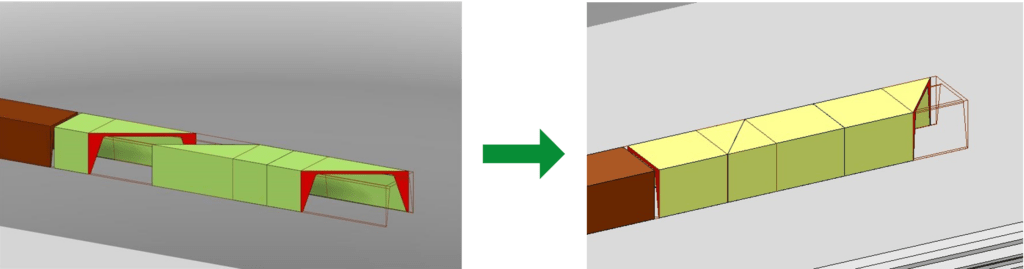
For Almacam Tube, a new dedicated algorithm has been developed for profile sections such as U-, H- and L- beams to optimize the distance between profiles in a nesting layout. Its purpose is to maintain the user-defined spacing between profiles and apply common cuts whenever possible. In this way, the algorithm helps improve material utilization.
The examples below show the same profile nesting before and after optimization with the new algorithm.
Consumption estimates
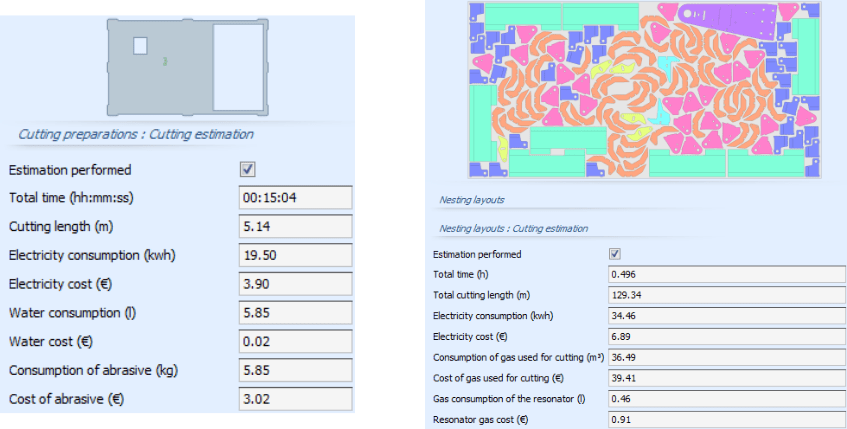
To help optimize resource and energy use, Almacam is now able to provide estimates of gas, water, abrasive, and electricity requirements for each cutting job. In this way, Almacam helps workshop users better assess the resources needed for their production, as well as control operating costs.