



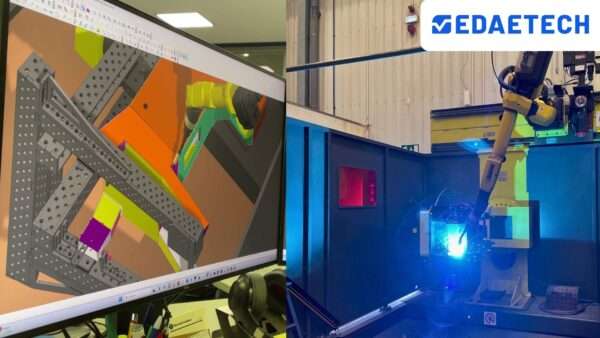
Edaetech manufactures complex metal parts and assemblies in Portugal, particularly for the automotive and aerospace industries. To improve data continuity between its 3D CAD environment and welding robot programming, the company developed a new workflow base on the OLP software Almacam Robotics.
Edaetech: complex metal assemblies for the automotive and aerospace industries
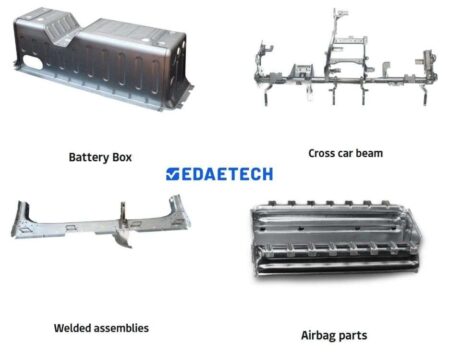
Founded in 2002, Edaetech specializes in the engineering and manufacturing of complex metal parts and assemblies, from prototypes to series production.
The company works particularly for the automotive and aerospace industries and manages a large part of the manufacturing process in-house: 3D CAD and engineering, 2D and 3D laser cutting, 3- and 5-axis machining, stamping, bending, manual and robotic welding, and assembly.
Its portfolio includes automotive structures and subassemblies, engine parts, thermal systems and various welded assemblies.
The challenge: maintaining data continuity from 3D CAD to robotic welding
For Edaetech, automation is not simply about having a high-performance welding robot.
For complex assemblies, a large amount of information is already defined in the 3D CAD environment. This information then needs to be used when preparing the welding operations and programming the robot.
Some of this information still required manual rework or adjustments when preparing robot programs. When several projects are managed at the same time, these operations increase preparation time and create a greater risk of inconsistencies between product design and manufacturing.
Edaetech therefore wanted to:
- reduce manual rework and repetitive tasks;
- limit inconsistencies between design and production;
- further standardize robotic programming methods;
- reduce preparation times;
- manage several complex projects in parallel more efficiently.
The objective was to strengthen digital continuity between 3D CAD and the welding robot.
The solution: using Almacam Robotics to improve data continuity from 3D CAD to robot programming
The project brought together three complementary areas of expertise: Edaetech’s teams, Roboplan for the robotic environment, and Alma Ibérica for offline programming with Almacam Robotics.
Edaetech brings its knowledge of the parts and assemblies to be manufactured, its 3D CAD data and its actual production requirements. Its teams define the needs that the programming workflow must address.
Roboplan is a Portuguese integrator specializing in industrial robotics and automation.
Alma Ibérica provides Almacam Robotics and its expertise in offline programming (OLP). The software is used to prepare welding operations and program the robot offline in a 3D environment representing the robotic cell.
The three teams focused in particular on making better use of welding information from 3D CAD and maintaining this information through to robotic programming.
The project was therefore not simply about adding software to a robot. The aim was to better connect Edaetech’s technical data, the robotic environment and the programming software.
Results: less manual rework and more structured robot programming
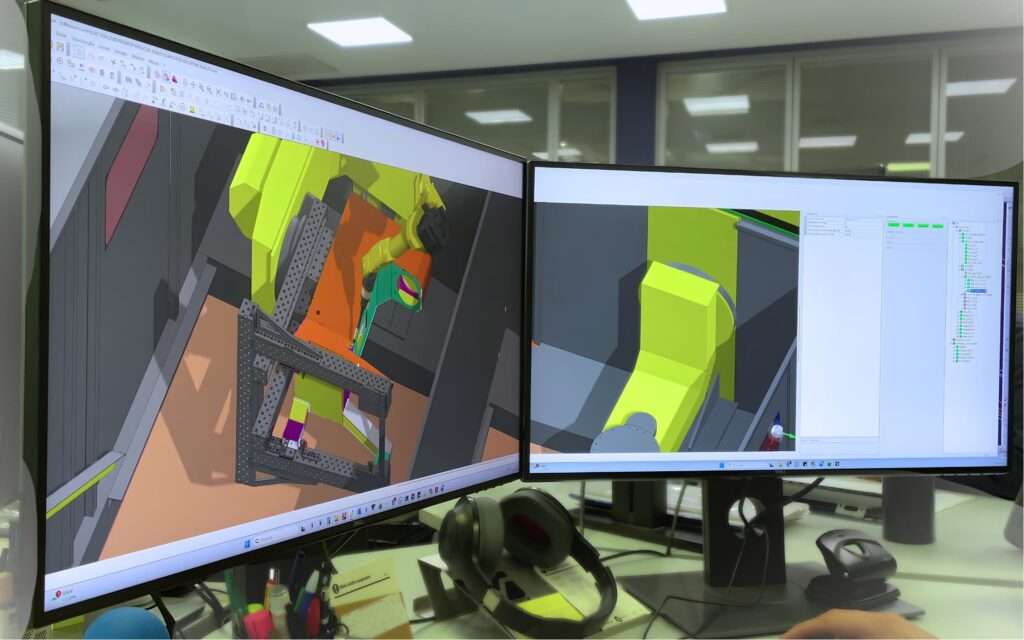
With Almacam Robotics, Edaetech can now prepare welding operations offline without using the robot for programming. The new workflow reduces repetitive manual tasks, simplifies welding preparation and provides a more structured approach to robot programming.
By making better use of welding data already available in 3D CAD, Edaetech has also improved continuity between design and production, which is particularly valuable when several complex projects are managed in parallel.
This project also shows that the benefits of robotic welding do not come from the robot alone. How data is transferred and used between design, offline programming and the robotic cell also plays an important role in the efficiency of the overall process.