



When Metalplasma, a subsidiary of the italian Gabrielli Group, had to control 5 laser cutting systems from 4 different machine builders, the answer was in a single CAD/CAM software: Almacam. The result: CN programs transferred from one machine to another in less than a minute, a single dashboard for the entire workshop.
Interview of Claudio Biondaro
Claudio Biondaro, Acting General Manager at the Grabrielli Group
The Metalplasma story: from craftsmanship to high-tech excellence
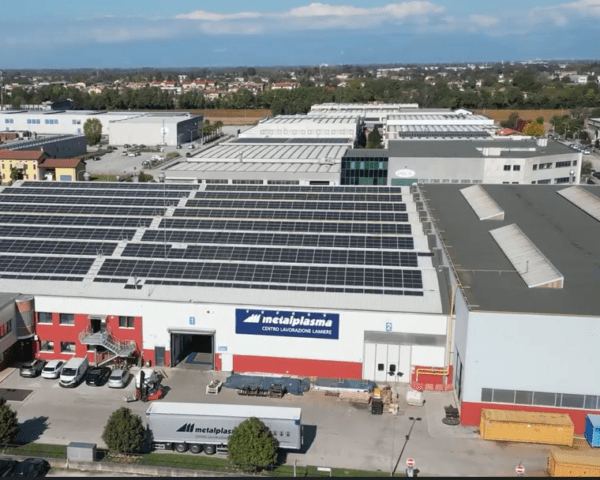
Founded over 40 years ago in Italy, Metalplasma has grown from a traditional sheet metal workshop into a fully integrated industrial partner and today stands as a key member of the Gabrielli Group.
What began as a local craftsmanship business has evolved into a high-tech production environment, spanning 15,000 m² and equipped with state-of-the-art machinery and robotic systems. From laser cutting and bending to robotic welding and assembly, Metalplasma masters the entire production chain under one roof delivering precision, flexibility and consistent quality to clients across demanding industrial sectors.
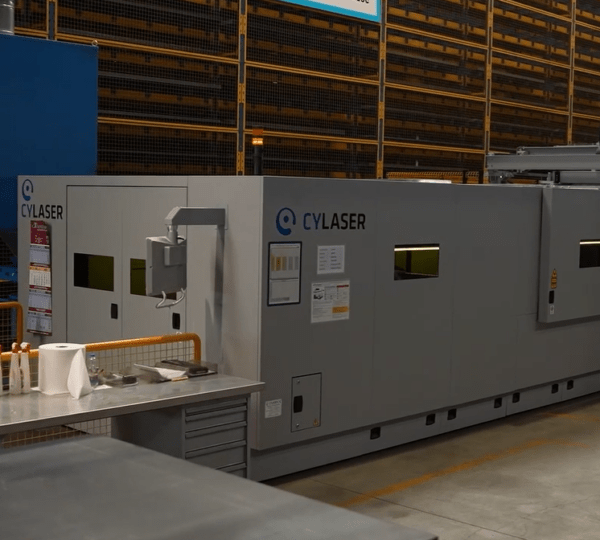
This is how Metalplasma came to operate five different lasers from Bystronic, CY Laser, Messer and TRUMPF, a diversity that creates challenges in everyday programming. As Claudio Biondaro, General Manager of the Gabrielli Group, explains:
In a company like ours, the technological choice is always dictated by the need, the format, the material, the thickness. We choose the cutting machine adapted to the job, not the one that corresponds to the catalog of a single manufacturer. But this decision comes at a price: four control systems, four programming logics, four ways of doing the same thing.
Managing multiple machines, multiplying constraints
Operating several laser cutting machines from different manufacturers creates daily complexity. Each system has its own programming logic, formats and interface, forcing teams to repeat the same tasks in different ways. This increases programming time, raises the risk of errors, and makes training more demanding.
The challenge is operational: this fragmentation limits flexibility and makes it harder to balance workloads or react quickly.
Using a single CAM solution to program all machines was the only solution to addresses this directly.
A solution to replace four: how Almacam has changed everyday work
We chose the best machines. So, we had to choose the best software to program them!
Denis Stangherlin, Head of the technical office, describes a drastic before and after:
Before, transferring a program from one machine to another was a slow and manual operation. Each system had its own logic. Now, with Almacam, you can work in a single environment and you can redirect a cutting program to another machine in less than 30 seconds.
Alma’s CAD/CAM and nesting software provides a unified environment while supporting machine-specific configurations, with dedicated cutting tables for each machine. The result is a single operational system that covers the entire machine park.
We have not replaced our machines. We have not standardized everything with a single manufacturer. Rather, we connected what we had.
Almacam operates now as an open environment exchanging data with ERPs, MES and other information systems. Imports and exports are fully configurable, adapting to the workflows of the Metalplasma company rather than the other way around.
In a world of shrinking batch sizes and lead times getting shorter, this adaptability is no longer an advantage. This is the condition for remaining competitive.
Fewer adjustments, better efficiency, zero bottlenecks: the numbers behind the transformation
Each nesting created in the software is compatible with all five machines. Thanks to rules built around the type of material and thickness, the same cutting plan can be validated and sent to a machine in seconds and not hours.
For a service center like Metalplasma, this translates directly into reduced set-up times, better sheet metal yield, and the ability to rebalance the load between machines in real time. When a machine is busy or at a standstill, the work does not stop, it moves. It's this kind of resilience that really makes a difference when you manage sectors as varied as glass, packaging, industrial parts and cable transport at the same time.
Safety and quality, the two priorities that Metalplasma places above volume, are also reinforced by the standardization that Almacam brings. With unified programming logic, the risk of human error in translation between systems disappears.
Metalplasma’s story offers a useful testament to the idea that digital transformation does not require a clean slate.